

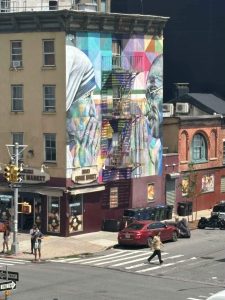
The mural I selected depicts Mother Teresa and Gandhi staring at one another while holding their hands in prayer. The mural is painted with multiple colors and intricate patterns, creating a kaleidoscope-like effect that symbolizes unity between the two figures. Although this mural could technically be replicated as a painting or photograph, I do not believe a replication would evoke the same emotions as seeing it in person. As John Berger discusses in Ways of Seeing, viewing a work through a screen is different from experiencing it in its original setting. When I saw the mural in person, I felt a sense of awe because of its grand scale, complexity, and the amount of detail that cannot be fully appreciated through a screen. The mural’s location also contributes to its impact. Because it is painted on the side of a building above a food market, it becomes part of the neighborhood and its surroundings. Seeing it in its actual location allows me to experience not only the artwork itself but also how it interacts with the community around it. If the mural were reproduced as a painting and displayed somewhere else, it would lose some of that connection to its original environment. Therefore, while the image of the mural can be replicated, the experience of standing in front of the original cannot be fully reproduced.

