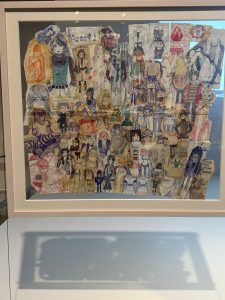
photographcollage drawing

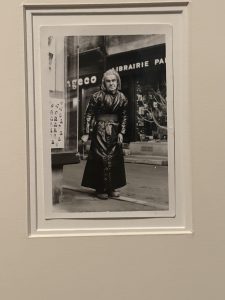
The first piece I’ve chosen to highlight is a choreographed self portrait by Marcel Bascoulard. The series showcases multiple self portraits taken between the 1940’s up until 1978 with Marcel posed in dresses and Victorian style wear. I chose to highlight this piece due to the authenticy that bleeds through the frame. Something I realized about the concept of being punk is that it can be exhausting if its not innately apart of who you are. You can look at Marcel and just know that he couldn’t be anybody else even if he tried. To me that is the very definition of punk.

The next piece I’ve chosen to highlight is by Ariane Bergrichter. This piece showcases a collage style series of fashion outfits, all seemingly made for a particular character/individual. Some of the outfits actually look like outfits worn during the core “punk” time period. Others are seemingly “regular” but still somehow manage to feel one of one. Each outfit seems like it would empower somebody to simply exist in the world and take up space. To the average individual this may seem easy but for many its not. Punk as a culture and philosophy provides its people with an armor that allows them to do this exact act, and live their lives the way they truly desire, not how society tells them to.

I don’t think either artist intended for the work to read as punk. I think they were both just being themselves and creating what felt true to them. There’s nothing more punk than that.
Blog Post 5

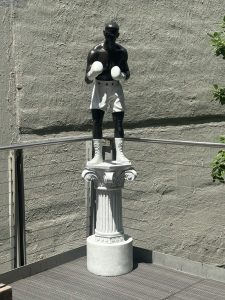
Boxer

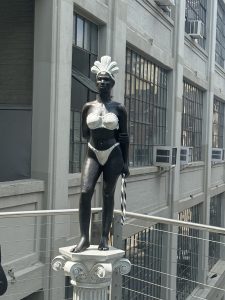
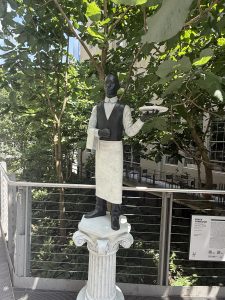
The piece or pieces rather that caught my eye the most at the High Line were Derek Fordjour’s ARCHETYPES series. The sculpture based installation focuses on three entertainment/service based archetypes that Black people have fulfilled: the burlesque dancer, boxer, and waiter. Each role is embedded in themes of empowerment and exploitation, and showcases a fraction of what Black people have had to endure to advance in society.

What caught my eye most about these pieces was their strategic location. They weren’t placed near a highly favorited tourist view, but in a seemingly “normal” positioning in comparison to the rest of the art installations on the High Line. Despite their positioning, they still forced you to stop and engage, coming closer to truly look at and appreciate the piece.

I don’t think it would be possible to replicate these pieces and truly capture their essence 100%. Not just because of the weight the bronze originals carry, but because of even where they were installed. Some people might ignore them on their High Line stroll, others migjt stop and stare enamored. That is one of the key common through lines of the Black experience in America. By replicating the piece without replicating the installation location, you lose an element of the story being told.

Blog Post #4

During the visit from Queer Van Kult, I asked if they would describe themselves as successful. Zoe responded and said that she wouldn’t yet described the collective as such and went on to describe other milestones that needed to be reached before they could claim the term. It was interesting to me because from the outside looking in, I would’ve disagreed.

I believe that when asked about success a lot of times people focus on the pinnacle of it versus seeing it as a journey, that still allows them to claim success even when things haven’t full peaked yet. I’m beginning to realize that collectively, we don’t give ourselves enough credit or grace when it comes to realizing our accomplishments. It’s very easy to complete one goal and move on to the next. It’s a lot harder to sit in the success of your foundational goals, even when a previous version of you could only see the next step. I think that through Zoe’s answer along with my own reflections on success, I’m learning to view success a bit differently. Accomplishments are fleeting, but the journey to get there is what actually lasts.

Blog Post #3 – MoMa


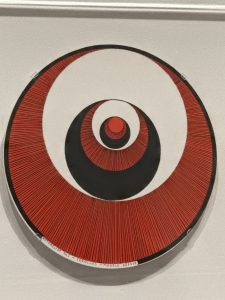
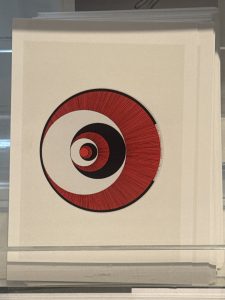
I chose to analyze on of Marcel Duchamp’s Rotoreliefs (Optical Disks) made in Paris, 1935. The impact of this piece is changed when it becomes a print, because it can no longer serve its’ original purpose as a toy. However, when looking at it as just a piece of art, the copy can be enjoyed just as much as the original.
Seeing the print of the piece made me realize that sometimes its easier to own the copy rather than the original. The print becomes a memory of your first interaction with the original, while the original sits as its’ own being, adorned with the energy of its’ creator and all hands that have touched it. Consequently, I believe that the memory you hold on to through the print can be just as important as having an attachment to the original.
Seeing and understand the connection that people can hold to both an original piece of art and its’ adaptations/replicas showed me that you can’t fairly the two. It’s like comparing apples to oranges.

Blog Post 2


polaroid portraitportrait of women with dogs

I was reluctant to be the subject of this photograph. Definitely more so than Katie and the dogs in 1885. Maybe if I was accompanied by dogs,  I would’ve felt more at ease. I guess we’ll never know.

I think in a photo setup such as this one, it’s a bit easier to allow oneself to be shown, than in the masc presenting outfits Alice had her friends wear. Yet still, my reluctance is more than evident. However, while at the Alice Austen house, I thoroughly enjoyed myself. I felt more than at ease – albeit, you wouldn’t think that by looking at my portrait. 

I think when it comes to photography, especially Alice’s, it’s easy to be in awe of the moments captured, as they transport us to another time. However, it’s also easy to forget the vulnerability of the subject in allowing themselves to be captured. 

The LGBTQ+ community has been targeted and attacked since the beginning of western civilization, and maybe even before. Joy and vulnerability are expensive, and not afforded to everyone. Even when they are accessible, the capacity to experience them doesn’t always exist. So as I sit here with this photo, looking at my own discomfort, I can understand how even Alice’s community at that time could still struggle with their essence being captured. I don’t think my discomfort is a foreign concept, it’s just a vulnerable one.