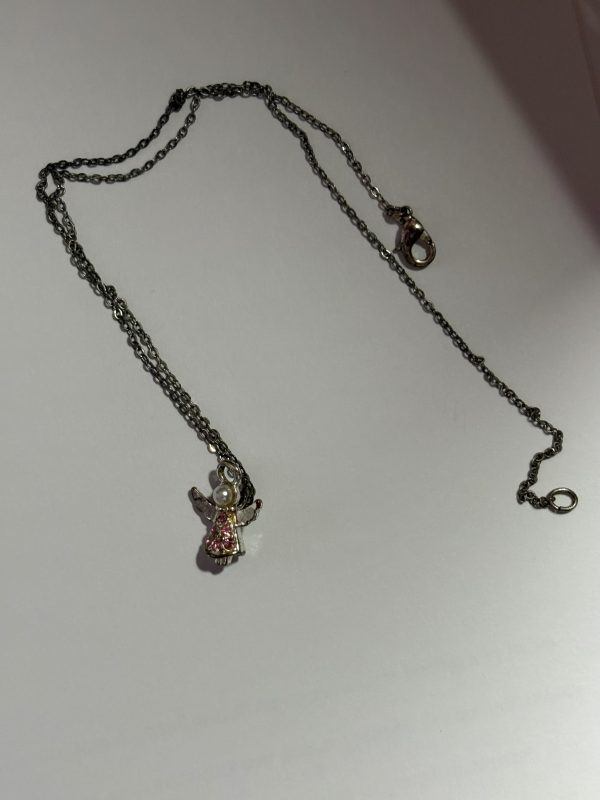
When I was born, my great-grandmother traveled from Argentina to New York City, where she gifted me and my twin sister necklaces. Each necklace had a silver charm of an angel, with a pearl for its head and gems lined up along its body. Similar to my sister and I, the necklaces were identical, except for one difference. The gems on my necklace were pink, while the gems on my sister’s necklace were blue. As my sister and I grew up, our favorite colors later became the same ones on each of our necklaces. Although the necklaces are such small objects, they always held a deeper meaning within our family. By gifting these necklaces to us, my great-grandmother created a connection between generations of our family. She passed away when I was young, leaving me with very faint memories of her, but my necklace still serves as a reminder of this connection and of my Argentinean heritage.
Refuge to Service
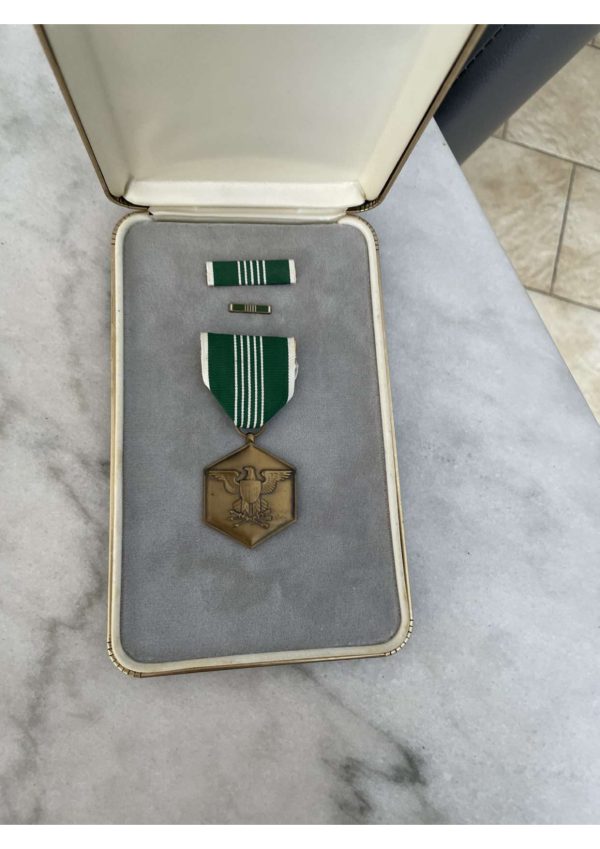
This Army Commendation Medal was awarded to my grandfather, Captain Murray Kohn, for his exceptional service as a dental officer at Fort Benning, Georgia, from 1970 to 1972. Born in the Bronx in 1943, Murray was the son of Jewish immigrants who had escaped the rising tide of antisemitism in Austria and Poland just years before his birth. His father, David, fled Austria in 1939, while his mother, Shirley, arrived at Ellis Island in 1926. Growing up in Washington Heights, Murray’s path to American identity was defined by education and service. During the Vietnam War, he entered the military through the “Berry Plan” as an obligatory volunteer, ensuring the health and readiness of soldiers heading to and returning from the front lines. This medal represents more than just military merit; it symbolizes the full circle of his family’s migration story. For a family that had fled state-sponsored persecution in Europe, Murray’s service as a commissioned officer and his receipt of this honor marked a profound transition from being outsiders seeking refuge to being integral protectors of the American nation. As the only dentist in his cohort to receive the medal, it stands as a testament to the “steady hands” and exactitude he inherited from a lineage of survivors. Today, this object serves as a bridge between his parents’ struggle to reach America and the civic legacy he built for our family.
Hamsa’s Hand
July 12th, the day of my birth and unbeknownst to me was that I shared this special day
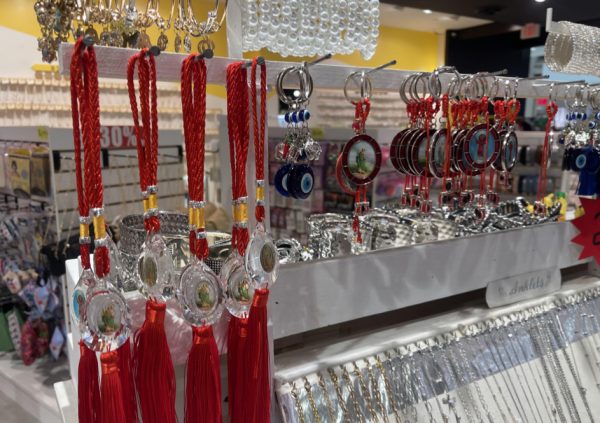
with my great grandmother, in my lifetime I will never have gotten to meet her. But I did know my abuela, and she is the one who tied the red evil eye anklet around my foot. This would have significant meaning because of my great grandmother, the eye looked to not only protect me from ill-intentions from outsiders but also honor the most divine protector I have in my lineage. The evil eye travels continents, cultures, and across time–for it to have reached me goes to show how strenuous its passage has been throughout generations. As someone who is mixed, only my mother’s side upholds these beliefs, and as do I, I find this creates a dynamic connection as to how I relate to each side of my blood. I share my mother’s side’s big eyes, button-nose, and shortened height. One of the few attributes that make me unique to them, I was raised in a family-oriented household, where we were all dependent on one another somehow and this made our bond stronger. Food, of course, had its own hold on our way of preserving our culture, having fusions of food but also ensuring we have traditional dishes that keep us all around a table together, laughing and having a good time. Above our heads, the air held our beliefs and faith after we prayed over what we were to eat and while we didn’t have much, looking around the table, it was more than enough. Whenever I miss this feeling of home, I run my fingers over the woven red string, the steel hamsa hand, and colorful beads woven into the anklet. Its mostly used to guard one’s spirit, and used as much as needed, it will break once it has fulfilled its duties. I have gone through many anklets because of this, I feel safeguarded when I wear it, and because the tradition began with my abuela to honor my great-grandmother I feel prideful of our shared spiritual values. Though if I could speak to my anklet, I would like to ask how far it truly comes from, did the indigenous groups of my heritage also shared this bracelet or had they been the ones to begin its ripple effect that circled all the way back to me. One must know that you can’t obtain an evil eye for yourself, it must be gifted as if reversed you also recede its purpose. It’ll teach you that instead of carrying the anxiety of how others think or wish of you, you must leave it to what can hold it, as humans–we can only do so much. So in a way by wearing the anklet you are also saying baja con dios.
NYC Postcard
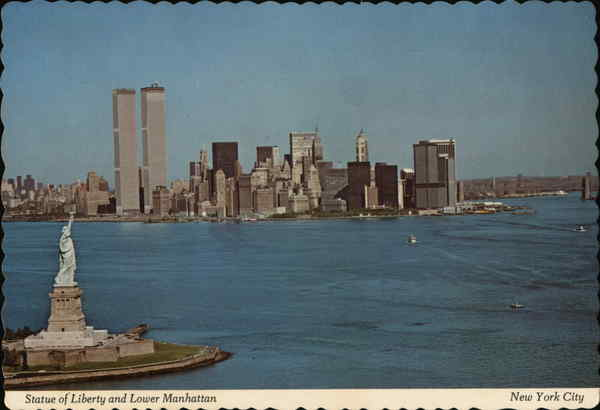
In terms of immigration or migration, I may be a citizen but that is only because of the stories that come from my parents before me. My mom immigrated from communist eastern Europe to the United States when she was just eighteen years old. She was born in 1970’s Hungary, during the cold war and occupation of several countries by the Soviet Union. Life during this time was far different from how it is now, with communism and socialism playing roles in my Mom’s life. In 1989 communist rule in eastern Europe collapsed with the dissolution of the Soviet Union and the transition from communist rule to a democratic system in Hungary. Two years later was when she first came to the United States all by herself. My mom was raised in a smaller town, so she was always amazed by the big American cities that were on TV, especially New York. More importantly, she also had a postcard displaying the big buildings in Manhattan. It served as another form of seeing what other parts of the world look like, and what her life could be or look like as well. That postcard she had was something that really helped to give that ambition to change her life trajectory by doing what not many can muster the confidence for in immigrating to NYC alone, and is a big part of why our family is here today.
From One Apartment to the Next
In the 1940s, my great-grandmother, Elza Weinman, and her family fled the Nazis in Belgium and eventually settled on the Upper West Side of New York City. They first lived at 145 West 86th Street, where many other Belgian Jewish families who had also escaped Europe began rebuilding their lives. A strong community quickly formed around shared history and culture. West 86th Street was an ideal place to start over because it connected residents all over Manhattan. The neighborhood was lively, filled with shops and businesses, and it was especially known for jewelers like her husband, Leon. While living there, she attended high school and soon after got married and moved just down the block to 98 Riverside Drive. When they were expecting their second child, they needed more space and moved again to 200 West 86th Street for the next 67 years. Those visits are the only memories I have of my great-grandmother, who passed away during my early childhood. I remember being ten years old when my mom would pick me up from school to go visit her. We took the elevator up to the 14th floor, and I remember this vividly because it was when I learned a 13th floor doesn’t exist. We spent the night playing games and watching the Giants vs. Redskins game. The following morning ended with the sweetest treat of all: Dunkin’ Donuts and the tightest, slightly painful, squeeze on the cheek. Although the apartment is gone now, its story lives on, because the journey that brought my great-grandmother to New York City eventually led to me growing up at 225 E 6th Street, a Jewish-built community as well.
“Habichuela con Dulce”
Have you ever eaten a dish that reminds you of your childhood? For me, it would be eating habichuela con dulce, a sweet bean dessert that reminds me of my ethnicity. It isn’t just a dish to eat; it represents the history, culture, and the strength it took to make it with a variety of infused cultures. This dish, originally from the Dominican Republic, is a part of who I am as a person. When I was younger, my mother always made habichuela con dulce during a specific time, which was Holy Week. The tradition that was introduced to me was that this dish had to specifically be eaten on Good Friday to give thanks for Jesus Christ sacrificing himself for us and also to bring blessings to the house. At first, I never believed in that tradition, but as I got older, I started to realize the true significance of this dish and also the happiness that it brings around. The specific recipe that my mom uses was passed down through generations, where she was taught by my great-grandmother. Every time this dish is made, it brings me great comfort because of the smell that enters my house, as well as joy because of the flavor. This dish often gathers my family, no matter what may be going on in their lives, because it’s tradition to eat together during Easter. It is a time to relax and enjoy the gift of life that is given to us.
The Megillah
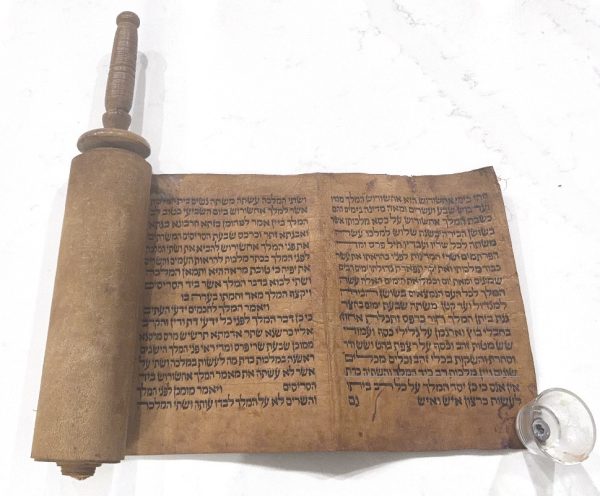
This Megillah was a constant companion in my family’s journey across multiple countries, keeping them connected to their roots. A Megillah is a Hebrew scroll read every year on the holiday of Purim. This Megillah was made in the city of Tetouan, Morocco, where my family lived until the mid-20th century. In the 1950s, after Morocco’s independence, the Megillah took on a more meaningful role in my family. Tension rose between the Muslim and Jewish communities in Morocco. Families started to leave behind the only lives they knew in order to escape the pressure. My family moved to Israel, where they could freely practice their religion. Due to economic difficulties, my family migrated to New York City in 1982, their final destination. Despite various moves, the Megillah has remained a constant pillar and has become a symbol of their identity. Today, our family’s Megillah is read annually in my local synagogue on the holiday of Purim, a community tradition. This object represents the immigrant experience in America by blending personal experiences and community. NYC is a city built by generations of immigrants who have each brought their own unique culture. The Megillah is an example of how culture and tradition can be maintained while still being part of a broader American identity.
Family Cookbook
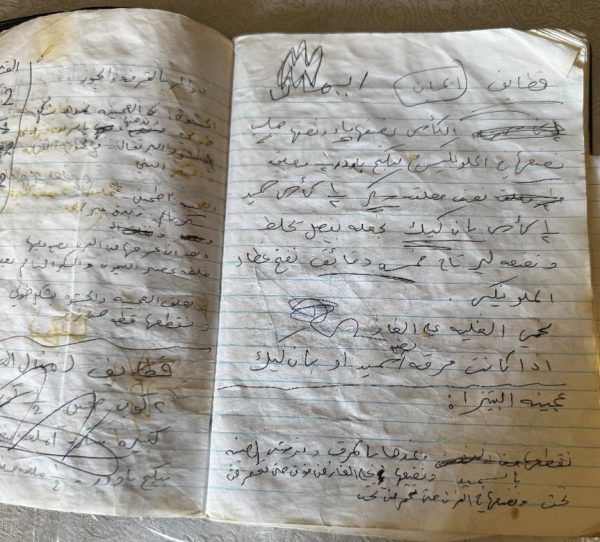
This is a photo of a page from a cookbook my mother has had all my life. The notebook is old and clearly well used, with wrinkled pages, faded ink, and small stains from ingredients that were probably spilled while cooking. My parents’ main language is Arabic, which makes sense for the recipes to be written in Arabic as well. Typically, Arabs don’t follow recipes. If you asked an Arab mother how to make a dish she would tell you, “Just add a little bit of this and all the spices you have in your cabinet” (safe to say Arab food is never under seasoned). But my mother made this cookbook specifically for desserts. She’s not much of a baker as it requires precise measurements, so to make it easier for herself she wrote the recipes down. If anyone can read Arabic, they can tell that this recipe isn’t exactly as specific as a recipe written in English, but it’s specific enough that any Arabic speaking person will understand it. This book is important because it carries the different desserts the represent the culture my parents left behind when they came to the United States from Palestine. It was a way for them to bring with them a piece of home where they started their new lives.
The Passover Spoon
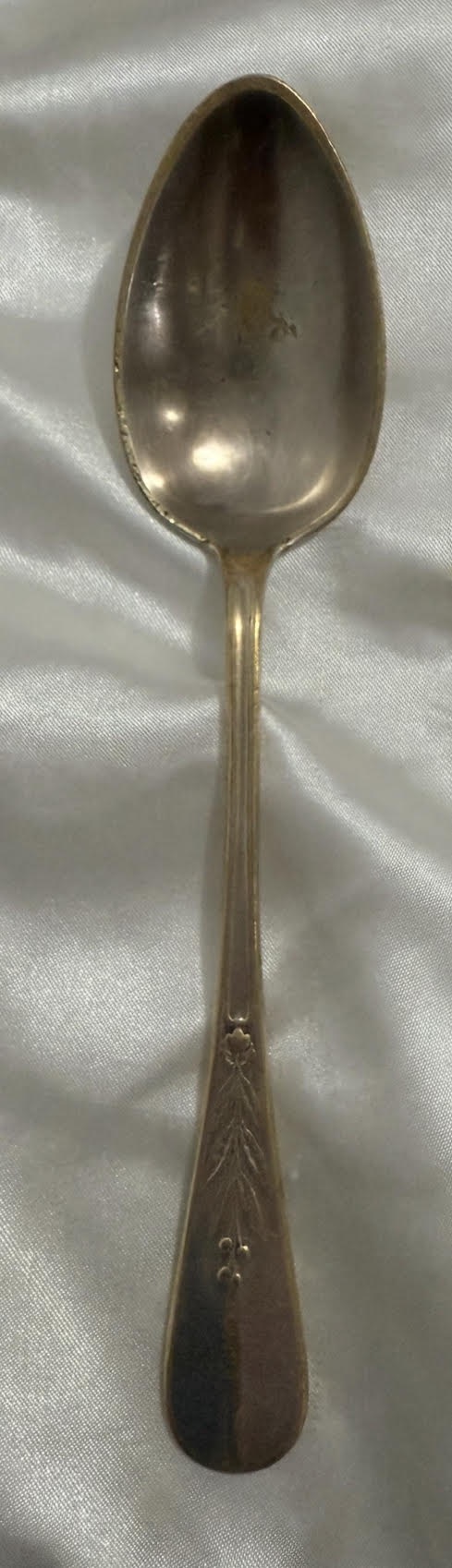
From Silk Road trading tables to my family’s Passover seder in Queens, this gold-plated “Passover spoon” has carried nearly two centuries of movement across continents, holding a significance far greater than the meals it serves. Each year at our Passover seder, we share a bite of my grandmother’s Plov from this spoon, preserved since 1828. As a child, I was fascinated and repelled by how many mouths the spoon had touched, but now I see it as a witness to migration, trade, faith, and continuity. Family oral history suggests the spoon was acquired through trade, reflecting generations of interactions and shared meals among Muslims and Jews in Central Asia. My father’s side of the family are Bukharian (Mizrahi) Jews with roots in Iran, Afghanistan, and Syria, who worked as merchants along the Silk Road before settling in Tajikistan. They lived under Russian and Soviet rule until my father immigrated to New York in 1992. Earlier periods reflected coexistence and shared commerce between Muslims and Jews, but rising antisemitism and restrictive Soviet policies led to major waves of Jewish emigration in the 1970s and early 1990s. Religious holidays, meals, and language unify my family. We speak Russian, Bukharian (a dialect of Farsi), and English. This spoon brings these elements together in a single ritual. In Queens, one of the most ethnically diverse places in the world, our Passover table reflects the cultural coexistence that shaped my ancestors’ lives along the Silk Road.
A sound carrier: My uncle’s talking drum
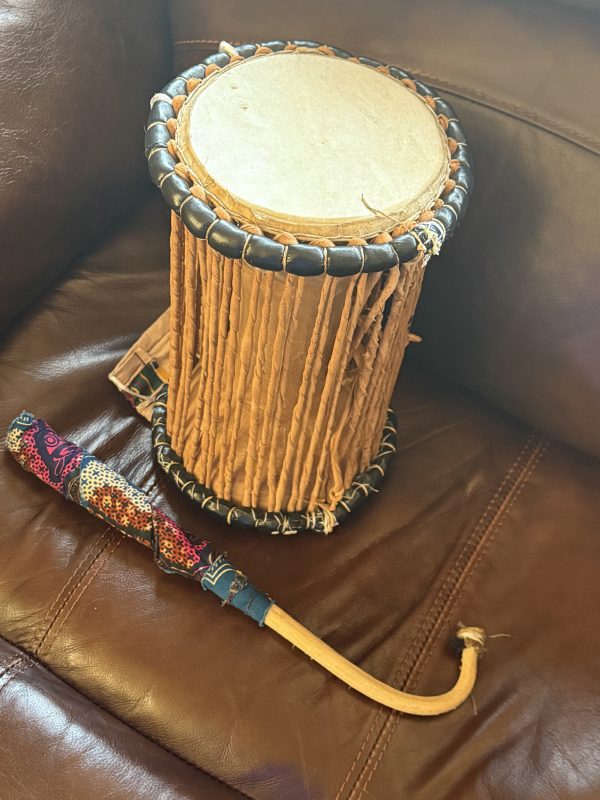
On a shelf in my uncle’s reading room sits a small talking drum. You can easily recognize it by its wooden frame, which is surrounded by leather strings and fitted with two leather faces. The drum only ever leaves the shelf when someone asks about it, and when it does, it always ends up in my uncle’s hands. He is very fond of it and his arms tend to fold around it like wings closing over a nest.
Traditionally, the drum is used during celebrations and coronations for kings because it has the ability to mimic the tone of a person’s voice. However, in my family, it takes on a different role. When it comes out, we gather around whoever is playing and take turns trying to guess what the drum is saying. When it reaches my uncle, the drum settles into a playful rhythm that makes people want to dance. Its crisp, tight sound is what first attracted my uncle to it. That sound was harder for him to find after he moved to the United States in the 2000s, which prompted him to get a talking drum of his own. The sound of the drum celebrates my family’s life in the U.S, but like a heartbeat, it is also a reminder of home. We carry the sounds of home with us, and the talking drum is my family’s way of sharing that sound.
The Dao – An Exploration of Bangladeshi Culture and the Immigrant Experience – Tajrian Jahan
An icon of the Bengali kitchen, the dao, a sharp, machete-sized seated blade commonly used by rural housewives to cut vegetables and fish, is an important symbol of Bengali village culture and a part of Bangladesh that my parents did not leave behind when they arrived here some 20 years ago.
The dao is a long, curved iron blade seated on a flat plank of wood or short iron tripod, used by squatting behind it and driving meat or vegetables into the blade. Its use dates back nearly 1,300 years to the Pala Dynasty in Bengal, a Buddhist kingdom in which early Bengali culture emerged; since the dawn of Bengali culture, the dao has been associated with the woman’s role as the nourisher and sustainer of the household.
The dao is also evidence of the sacredness of the bare earth in early Bengali culture. Toiling behind a dao, sharing a meal, and sleeping were all practices performed on the ground because the Earth and its soil were sacred. With the arrival of British colonialists, furniture and stovetops began to gain popularity and we lifted ourselves off these sacred grounds; using a dao became a symbol of rural meekness against Western culture. My mother came from a riverside village in Sylhet, and I remember watching her cut the same hyacinth beans she had once watched her own mother cut; she embodied the motherly spirit of the dao, and brought the essence of Bangladesh to our small apartment in the Bronx.
The Tawa
The tawa is a flat metal pan found in kitchens of many Pakistani households. The pan can be completely flat or concave, and is typically made of cast iron, aluminum, or carbon steel. Its origins trace back to the Indus River Valley civilization, where flat clay discs were used to cook flatbreads over open fires. These early versions were designed to distribute heat evenly, cooking unleavened bread without burning it. As metallurgy advanced, clay gave way to metal. Cast iron tawas remain the most popular due to their improved heat retention, ideal for rotis and parathas, while carbon steel versions are lighter and more modern, suited for everyday cooking and quickly heating packaged flatbreads.
For my family, the tawa is how we hold onto our Pakistani culture. We own both a convex cast iron tawa and a flat carbon steel one. My mother uses the flat tawa to make rotis and parathas for my grandparents and I, while the convex one is reserved for frying puri and daal puri. The tawa instantly brings to mind Sunday morning breakfasts — daal puri or parathas with chickpea curry and a tall cup of chai. Our household makes many kinds of flatbread on it, including chapati, naan, roti, and dhalpuri. Less conventionally, my siblings and I also use it to fry eggs and make veggie omelets.
An archaeologist studying my family’s history would find the tawa invaluable: it is the foundational instrument behind the flatbreads that form the bedrock of Pakistani diet and culture.
The Power of Rice
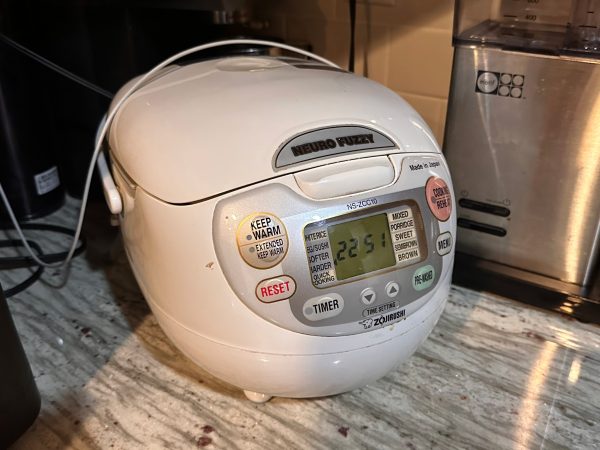
Anyone who lives in an asian household probably uses this every day. My family as well. For almost every meal, we have white rice. Eating rice with miso soup on the side is an essential everyday part of Japanese food culture, and I believe it is important to stay connected to it even when I am not in Japan.
The versatility of rice is what makes it special. Of course, you can eat it directly, but there are many other dishes you can make from rice itself. For example, you can shape the rice into a ball and put ingredients of your preference inside, called onigiri (おにぎり). You can season it with furikake (ふりかけ) or pour Japanese curry over it and enjoy it as curry rice.
The most important time of year for making rice dishes is the New Year. The rice is hammered together until it becomes one big blob, which we all know as mochi (もち). You can enjoy the plain mochi’s stickiness, or, for those who want some flavor, you can add soy sauce or sugar. The mochi is also used in soups called o’zoni (おぞうに) and oshiruko (おしるこ), both of which are traditional New Year’s dishes. The food Japanese people eat on New Year’s is different from the food they eat daily. My family sets up an entire feast, and instead of eating white rice, we eat mochi and other traditional New Year’s delights.
The Sil-Baata
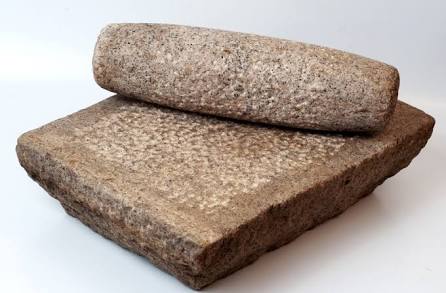
An artifact that highlights the culture of Bangladesh is the sil-batta [sheel baata]. This South Asian tool dates back to 2500 BCE during the Indus Valley Civilization. The tool consists of two parts: the rough stone slab and the stone cylindrical grinder. Used in various South Asian countries including, Bangladesh, India, and more, the sil-batta was used to grind a multitude of spices including chillies, turmeric, ginger, garlic as well as lentils. Often used while sitting on the ground, the tool required great strength to grind the various spices by rolling the cylindrical piece against the spices laid on the slab in an upward motion. The concept of this tool highlights and exemplifies the hard work, patience, and grit carried out by South Asians from many centuries ago to now. Not only is it resourceful but also scientific because manually breaking down these spices releases greater flavor due to a proper breakdown of the cells of the spices, adding to the uniqueness and special flavor of South Asian cuisine.
From my experience, I do not use this tool with my cooking, especially since it is not as prominently used anymore, even in Bangladesh. However, growing up, when I went back home, I observed many of the house-helpers using the sil-batta to grind spices which encouraged me to try out the tool when I was young, though I was not very successful at it. I found this tool very interesting and personally unique to our culture though similar techniques are also applied in other cultures. Currently, for these spices, my family and I usually use a blender/grinder to grind ginger and garlic into pastes. A lot of the spices that we use, however, are generally store bought packs that come grinded. Though, if we have time to grind the spices ourselves, we do buy the spices from the store and grind it at home.
Overall, the sil-batta and its connection to the spices it is used to prepare highlights a significant distinction in South Asian cultures to the rest of the world and reflects the novelty of South Asian foods. This tool plays a role as one of the roots that connects me back to home.
Borhani
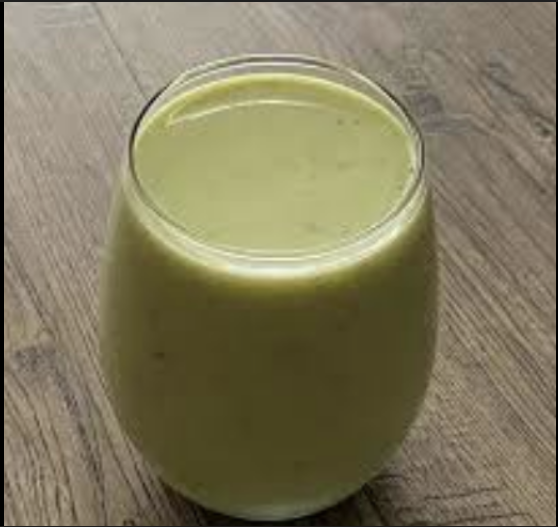
Borhani is a traditional Bangladeshi yogurt-based drink known for its spicy, tangy, and savory flavor. Deeply rooted in Bengali culture, it holds a special place at weddings, Eid celebrations, Ramadan iftar gatherings, and other festive occasions. Served chilled alongside rich dishes like biryani or tehari, borhani not only enhances flavor and aids digestion but also symbolizes hospitality and togetherness during large family and community events. The drink is made from a blend of sour yogurt (tok doi), sweet yogurt (misti doi) or sugar, mint, cilantro, mustard seed paste, green chili, black pepper, and lime juice. For many Bangladeshi families, including mine, borhani carries emotional and cultural significance. Although New York City’s diverse neighborhoods—such as Jackson Heights, Astoria, and Jamaica—offer a variety of Bengali foods, borhani remains a rare specialty we prepare at home, connecting us to our roots and memories of Bangladesh.
A deeper look at borhani reveals the drink’s historical and social dimensions within Dhaka’s culinary identity. Influenced by Mughal and Persian traditions, it reflects how yogurt-based drinks and aromatic spices traveled through empires into Bangladeshi cuisine. Differences in recipes, preparation styles, and availability also highlight social and class differences in Dhaka—from elaborate wedding feasts to adapted versions sold by local vendors.
Cookie Tin
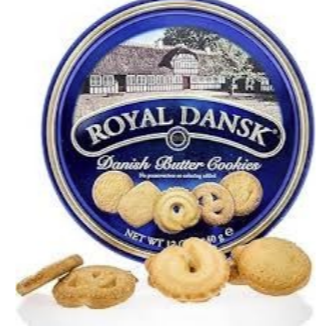
Although my artifact, a blue Danish cookie tin, didn’t originate in Pakistan, where my family and I are from, it’s been used in my family for almost 20 years. The tin originally came into our possession when guests brought over Danish butter cookies as a gift. After the cookies finished, we decided to reuse the tin due to its durability and sturdiness. Since then, this tin is always found on the corner of my counter, filled with flour that we use to dust our work surface when making different types of bread, from naan and roti to chapati and paratha.
This tin truly identifies the importance of resourcefulness in my family because instead of throwing out the cookie tin after the cookies finished, my family reused it. This tin specifically is perfect due to its durability, lightweight material, and depth, which makes it practical to hold flour and dip dough balls in. It also demonstrates the importance of bread in our family since it is eaten with almost every meal. After talking to my mom about this tin, she explained that in Pakistan, flour was traditionally stored in straw containers rather than metal tins, since Danish cookie tins like this were not very common there. Overall, my family’s continuous use of this container shows meaningful memories and significance, since it highlights how migration can also lead to the exposure of different products, like this cookie tin, that might be used in place of traditional family objects, like the straw containers.
Date Origins
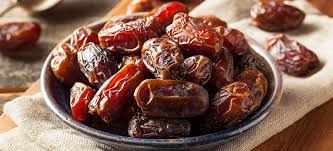
Dates are one of the oldest fruits people have grown, with farming going back more than 7,000 years to ancient Mesopotamia and the Arabian Peninsula. They played an important role across the Middle East and North Africa before many other crops were around, used as sweeteners, trade goods, and even fermented into wine.
In Islam, dates have a deep meaning. The Quran mentions them around 20 times, and the Prophet Muhammad is known to have broken his fast with dates and water. This tradition continues today, especially during Ramadan. In my family, iftar always starts with dates right after the Adhan, just like it did all the way back in Guyana. It’s not only sunnah, but a tradition I’m not sure will ever end for me. Dates are also included in the Bible and the Torah, where they also carry symbolic meaning in both Christianity and Judaism.
On top of tradition and religion, dates are very healthy. They have fiber, potassium, magnesium, and antioxidants, and their natural sugars give quick energy that especially helps after a long day of fasting. The pit inside, which most people throw away, can be ground into a caffeine-free drink called date seed coffee and has also been processed for centuries into kohl, a traditional eye cosmetic still used across the Middle East and South Asia.
There are several kinds of dates, each with its own taste and texture. Medjool dates are soft and caramel-like. Ajwa dates, grown in Madinah, are darker and richer. Deglet Noor dates are firmer, drier, and a little nutty. If you’ve never had one, try a Medjool first. It’s easy to find and sweet enough to show you exactly why people love them. They’re sweet, soft, and way better than any candy.
A recipe through time
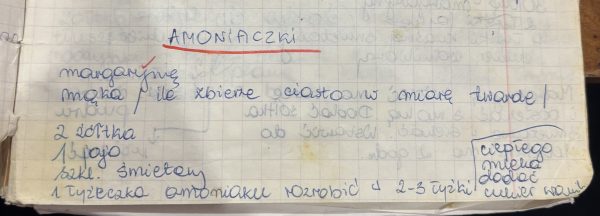
Ever since I was young, the holiday season meant baking desserts and sweet treats with my family. About 10 years ago, in 2016, my mother shared our family amoniaczki recipe with me and passed down the tradition of baking these cookies together. Made with ammonia powder, these cookies are crisp and airy. Also, when baking the cookie, a layer of brown sugar is baked on top which adds the sweetness to the cookies. For years, I thought this recipe was my mothers, until I learned it came from my great grandmother. She originally wrote it by hand in her recipe book with traditional Polish desserts and taught it to my grandmother, who then passed it to my mother when she was growing up in Poland. When my mother immigrated to New York in 2004, she brought this recipe book with the amoniaczki recipe to the United States. She used this recipe as a way to stay connected to her home and preserve her culture while raising her family, especially through her two daughters. Now, baking amoniaczki has been a tradition I continue, especially for Easter and Christmas. I also get to see my sister teach the recipe to my niece and continue to pass down the family tradition. I have seen this recipe for so many years, but now I realize what once seemed like a simple recipe has come to mean much more. It represents history and tradition passed down through generations of women in my family.
Double-headed Eagle
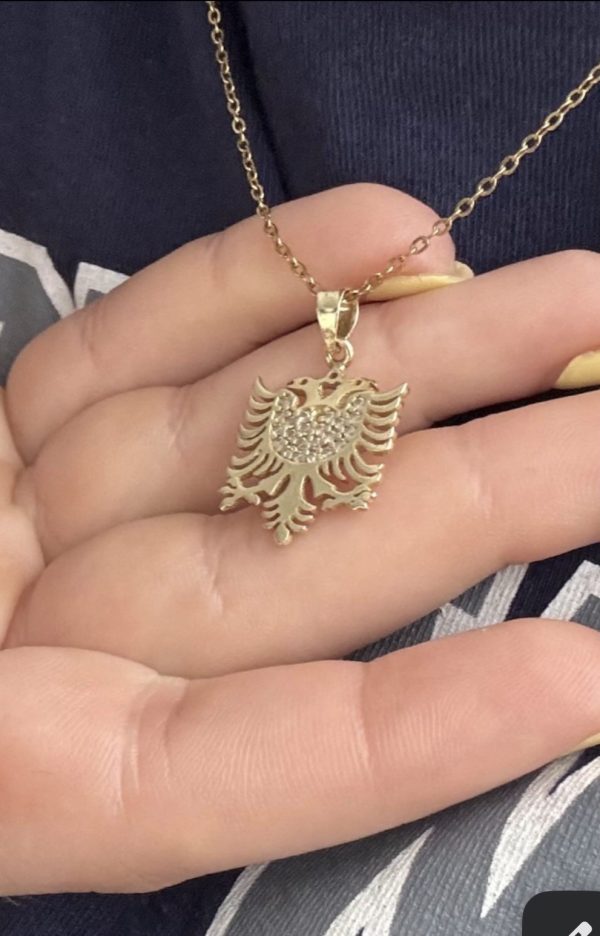
A single piece of jewelry bears the weight of identity, family sacrifice, and cultural survival across generations. My pendant is a small gold necklace featuring a gold double-headed eagle. Two heads are facing outward on a single body, mirroring the Albanian flag. As a first-generation Albanian-American, I did not grasp its significance until my mother gave it to me during my sophomore year of high school, a time when I was searching for who I was and where I came from. The two heads represent the unity of Albania’s two groups, the Gheg and the Tosk, and the nation’s position between the East and West. Under communism, the government forbade citizens from expressing national identity, yet the eagle was worn close to the heart, because identity cannot be legislated away.
My own parents were among the Albanians who left after communism fell. My father served in the military before boarding a boat to New York, where he rebuilt his life working in factories and pizza shops. My mother followed family members by plane, carrying Albania with her while forging something new in America. Together they labored to provide for my siblings and I. This necklace ties me to a country I did not experience firsthand, while enabling me to carry Albania’s history and my family’s story into my own American life. I now use this as a reminder to keep on working hard (just like my parents did) at the things that I want in life.
Persian Kabab
Kabab is a Persian dish eaten in Persian households and restaurants, as well as at family gatherings and celebrations. It has been a central Persian dish for almost 2,000 years, made with ground beef, grated onions, and turmeric placed on skewers and grilled. The dish is commonly accompanied with basmati rice and sumac and a grilled tomato. Kabab is unique as its preparation is communal; in family barbecues, we each work together to get the ground meat, onions, and spices ready, to put beef on the skewers, and to grill. Making cultural dishes is one of the central ways that my family and other Persian immigrant families keep our cultures and traditions alive in our new homes. For American immigrants as a whole, making traditional foods is one of the key ways of maintaining a tangible hold on our cultures and heritages, even when we are not in our homelands. Persian immigration to the United States has dramatically increased following regime change in Iran, with my parents leaving Iran in the late 1980s, and these cultural traditions and dishes always remind us of our family members still in Iran and all we had left behind. Our hearts are in Iran and the war brings pain and sadness to us constantly. We hope that the people of Iran will soon live in freedom and that the people of Iran will continue to flourish as they have for millennia.