The Dao – An Icon of the South Asian Kitchen

An icon of the Bengali kitchen, the dao, a sharp, machete-sized seated blade commonly used by rural housewives to cut vegetables and fish, is an incredibly important symbol of Bengali village culture and is a part of Bangladesh that my parents did not leave behind when they made the voyage to this country some 20 years ago.

The dao is a long, curved iron blade that is seated on a flat plank of wood or short iron tripod, and is used by squatting behind it and driving meat or vegetables into the blade in a pulling motion. Unlike in Western kitchens where food is prepared standing up, all food in traditional Bengali kitchens is prepared in a squatted position over a dao and an outdoor wood-fired stove.

The use of the dao dates back nearly 1300 years ago to the time of the Pala Dynasty in Bengal, a Buddhist kingdom in which the earliest forms of Bengali culture emerged. Collections of poems and terracotta sculptures from the time depict women squatting at their dao’s cutting fish; since the dawn of Bengali culture, the dao has been associated with the woman’s role as the nourisher and sustainer of the household.

The use of the dao is also evidence of the sacredness of the bare earth in early Bengali culture. Toiling behind a dao, sharing a meal with cherished visitors, and sleeping were all practices performed seated or lying on the ground; to stay close to the ground was paramount because the Earth and its soil were sacred, and one had to remain close to it. With the arrival of the British colonialists in Bengal, furniture began to gain popularity among the wealthy and we slowly lifted ourselves off of these sacred grounds. Using a dao became a departure from the British, Western culture imposed on us and a symbol of rural meekness and humility in the modern day.

My mother came to the United States from a small riverside village in Sylhet, Bangladesh where the dao was used extensively. She would watch my grandmother cut mountains of uri, or hyacinth beans, with her blade and toss them into a pot set over burning logs. My mother would purchase a dao in the United States and I remember watching her as she cut and peeled the same hyacinth beans that she’d watched her mother cut. She would rush to process as many beans as possible before she’d have to change the diapers of my younger brothers or feed them, and would leave water droplets that would rust the blade; she embodied the motherly spirit that the dao has always represented. My mother shared a piece of Bangladesh with me, her son born far from home.

My mother brought the essence of her village to our small apartment in the Bronx. The humble dao is truly a testament to how a culture can survive the twisting tides of change and migration.

Central Asian Manti

Manti are steamed dumplings that are common in many Asian cuisines including Uzbek, Turkish, and Afghan. In central Asia, they are usually made from thin dough filled with finely minced beef or lamb, onions, and spices. The dumplings are folded using special techniques and cooked in steamers. In different cultures, they have different wrapping techniques, but the basic idea is the same: A dumpling that brings people together around a table.

In my family, Manti represent a connection to my background. Preparing them takes time and is usually done together with my family. My sister makes the dough from scratch while my dad minces the meat and onions. Later, my mom rolls the dough, I fill them, and my dad wraps them. Because the process is slow and requires many hands, cooking Manti becomes a social activity where we talk, share stories, and spend time together. For me, Manti are more than just food. They remind me of where my family comes from and the traditions that have been passed down across generations even though we live in New York today.

Many immigrant families in the United States maintain traditions through food by making them with their families at home or opening restaurants. Dishes like Manti show how cultural identity can continue even after people move to new places, becoming part of the diverse food culture of cities like New York.

Uzbek Qozon

My grandmother has a qozon that looked like the one in the image, only much smaller. It was old and well-used. This is the qozon that made the food that my mom was raised on throughout her entire childhood. This is the qozon that made the food I was raised on during my childhood. It’s not a cooking utensil or a tool; at this point it’s an heirloom. It’s older than I am. It’s probably older than my mom. Its provenance, at least as far back as I can trace it, begins with my grandfather’s mother, who then passed it on to him. Being a stereotypical Uzbek man and not knowing how to cook, he gave it to his wife (my grandmother). My mom hopes to inherit it one day.
It’s funny just how much of Uzbek culture can be explained by this. Uzbek dishes are efficient: large and calorie-dense, a leftover (see what I did there?) from our nomadic days when little could be preserved and even less could be carried on the backs of horses. Because of this, Uzbeks traditionally have no concept of leftovers. My grandmother would cook three meals a day, every single day, each one big enough to fill this qozon to near-overflowing. The qozon is perfectly hemispherical, so an Uzbek kapkir (spatula) can very efficiently stir the food and scoop it out onto the plates of my grandmother’s four children. The pure cast iron gets hot and stays hot, and the material only gets stronger over time as it polymerizes with every use, preserving itself for future generations.
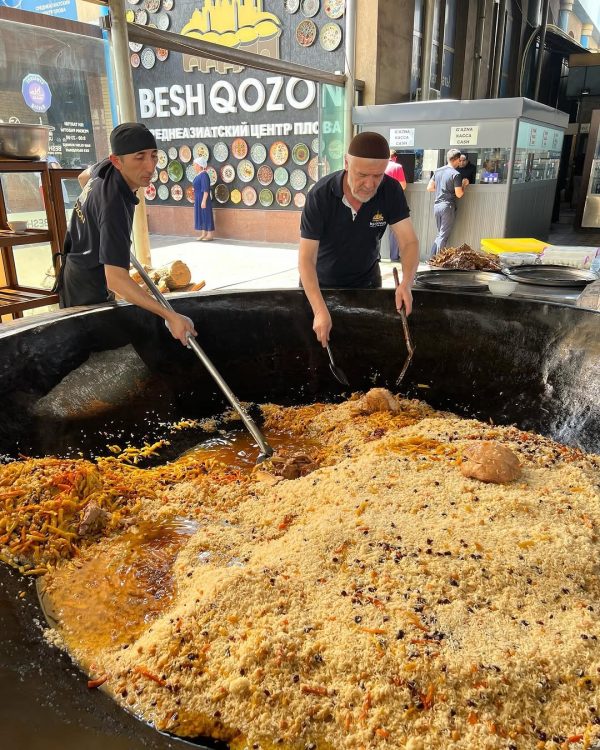
The second image is an example of a qozon used in communal cooking. These huge qozons are called “forty-ears” because they traditionally had forty handles, called ears, around the rim, and it would take forty men to carry them, one for each ear. There are restaurants in Uzbekistan that specialize only in one dish, osh, the national dish of Uzbekistan. The restaurant Besh Qozon makes portions of osh that weigh 350 kilograms (771 pounds).
I’ve had to describe it so many times, and each time I’m left underwhelmed because it’s impossible to experience it adequately (let alone authentically) unless you see it being made in front of your very eyes. It consists of Uzbek rice (not basmati or jasmine), julienned orange and yellow carrots, beef or lamb, spices, and toppings like whole peppercorns, raisins, quail eggs, stuffed grape leaves, whole garlic heads, or even quince. All of the toppings are not used at once; quince and garlic do not go well together. My favorite is fried in linseed oil, but the fanciest osh is made with dumba, the fat of a special type of ram only found in Central Asia.
Because osh comes in so many different forms, it is used in every aspect of Uzbek life: regular ol’ osh at home, fancier osh at restaurants and celebrations, and even fancier to’y oshi for weddings. The wedding, being the most important event in Uzbek culture, naturally gets the fanciest osh with all of the toppings. At the most old-fashioned of weddings, a ram and a big qozon are brought to the home of the bride. I think you can see where this is going. A butcher is called, the ram slaughtered, and some of the male relatives of the bride cook osh for the wedding. These days, things have become a bit more modernized. To’ylar (weddings) are usually held in to’yxonalar (wedding-houses), huge event halls specifically made for Uzbek weddings, which include 500 people on average.
From to’ylar to dumba to paxta-gul to osh, the qozon truly connects every facet of Uzbek culture together.

Proudly powered by WordPress | Theme: Baskerville 2 by Anders Noren.

Up ↑