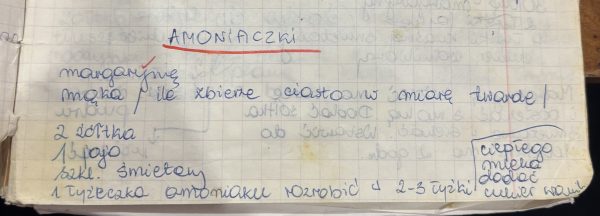
Ever since I was young, the holiday season meant baking desserts and sweet treats with my family. About 10 years ago, in 2016, my mother shared our family amoniaczki recipe with me and passed down the tradition of baking these cookies together. Made with ammonia powder, these cookies are crisp and airy. Also, when baking the cookie, a layer of brown sugar is baked on top which adds the sweetness to the cookies. For years, I thought this recipe was my mothers, until I learned it came from my great grandmother. She originally wrote it by hand in her recipe book with traditional Polish desserts and taught it to my grandmother, who then passed it to my mother when she was growing up in Poland. When my mother immigrated to New York in 2004, she brought this recipe book with the amoniaczki recipe to the United States. She used this recipe as a way to stay connected to her home and preserve her culture while raising her family, especially through her two daughters. Now, baking amoniaczki has been a tradition I continue, especially for Easter and Christmas. I also get to see my sister teach the recipe to my niece and continue to pass down the family tradition. I have seen this recipe for so many years, but now I realize what once seemed like a simple recipe has come to mean much more. It represents history and tradition passed down through generations of women in my family.
Threads of Light: From Cairo to New York
The object is a hand-size golden lantern that lights up with batteries. It has a handle at the top and a roof-like top, with a round base and two handles (mostly for decor) on the sides. The lantern was purchased by my mom in NYC. It sits on a medium-sized table within my house, mainly used for guests. Even though it simply looks like a fancy house decoration, it connects me with my culture and memories.
Growing up as an Egyptian, it was normal to see children before sunset running in crowded markets, pushing through adults while holding small lanterns of different shapes and sizes. They’d light up in different colors, not just golden yellow. Most of the time, the lanterns didn’t contain real candles. But they still felt cultural. Children would sing “Ramadan gaana,” and other different songs in anticipation of the month of Ramadan.
Because the small lantern signals Ramadan, it connects me to memories of fasting in Egypt on hot days, especially later in the day when I felt great for making it to the evening, knowing a large feast awaits my family.
This object fits into the broader story of New York City because New York City is a hub of immigrants, of many cultures uniting into one city. This makes New York so much different from other places in America. Being of an Egyptian background, I bring my perspective here, and even meet people from different countries who also celebrate Ramadan.