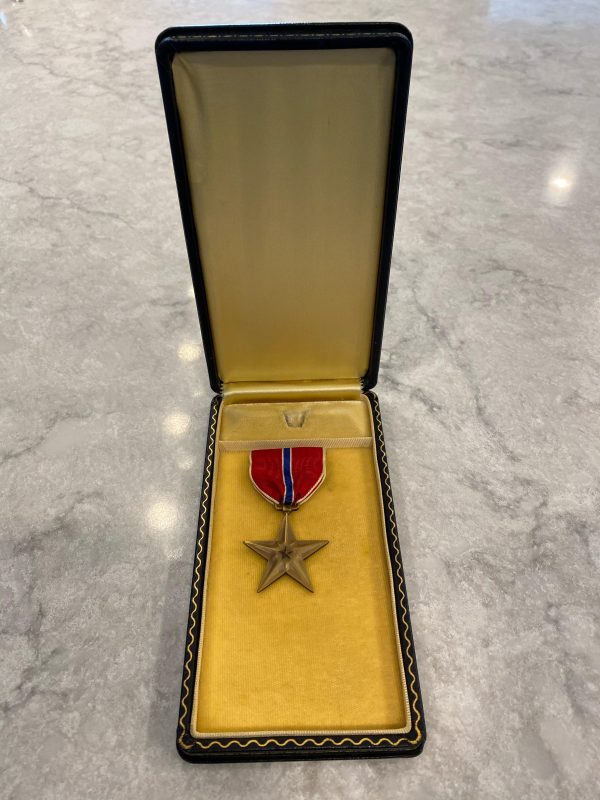
As a child, I was intrigued by the mysterious medal on my grandmother’s shelf, and I sought to uncover what this object is and why it deserved a place of prominence. As I grew up, I discovered that this was my great-grandfather’s Bronze Star medal, awarded in 1945 for his heroism and meritorious achievements during WWII, and an important symbol of my family’s immigration story. My great-grandfather, Manny Weinberg, was born in 1923 in Berlin, Germany, and fled to New York in 1939 as antisemitism and Nazi persecution increased. Following the attack on Pearl Harbor, he enlisted in the U.S. Army, hoping to fight the Nazis who persecuted him. A new military intelligence unit recruited him alongside other Jewish immigrants. They trained at the Military Intelligence Training Center at Camp Ritchie, Maryland, earning them the name “The Ritchie Boys.” My great-grandfather was in one of the first classes to graduate and deploy, landing on D-Day at Omaha Beach. As Jewish immigrants, the Ritchie Boys had the rare opportunity in which members of a community fleeing persecution returned to the place they fled and fought their oppressors. The medal symbolizes immigration to New York, wartime intelligence and how military service can reshape immigrant identity. My great-grandfather’s army service marked his turning point, deploying as a Jewish, German immigrant soldier, and returning to New York as a war hero, securing the right to consider himself a New Yorker and true American.
Bronze Star Medal